
True Destiny: Diana Flores on Journey in Flag Football, Navigating Adversity, Winning Back-To-Back Gold Medals With the Mexican National Team, Ventures Beyond the Field, Personal Legacy and More


There's a popular saying that goes, "Difficult roads often lead to beautiful destinations." For Diana Flores, her journey in the game of flag football is an embodiment of this very quote. A journey filled with undeniable adversity, but one where her passion, focus, and resilience have catapulted her into becoming a leading voice and one of the most decorated players in the sport. Born and raised in Mexico City, Diana remembers first being introduced to the game by her father when she was just eight years old. Despite playing other sports such as ballet and gymnastics growing up, there was something inexplicable about flag football that immediately drew her in. It wasn't all smooth sailing though. When reflecting on
her early days in the space, Diana recalls the challenges that she had to navigate through. "Back then, the sport was not popular. It was not well-known here. It was, of course, seen as a sport for boys only—for men—so there were not a lot of teams...I always saw all these women fighting for (the opportunity to) find a place in this world that made us feel (like) intruders," she states. Challenges which, in turn, served as personal fuel and motivation to reach her highest potential. From competing in all-boy leagues at 14 years old to joining the Mexican National Team at 16—and becoming the youngest player on the roster and to compete in an international tournament—, Diana continued to defy the odds and carve her own legacy in the game over the years.
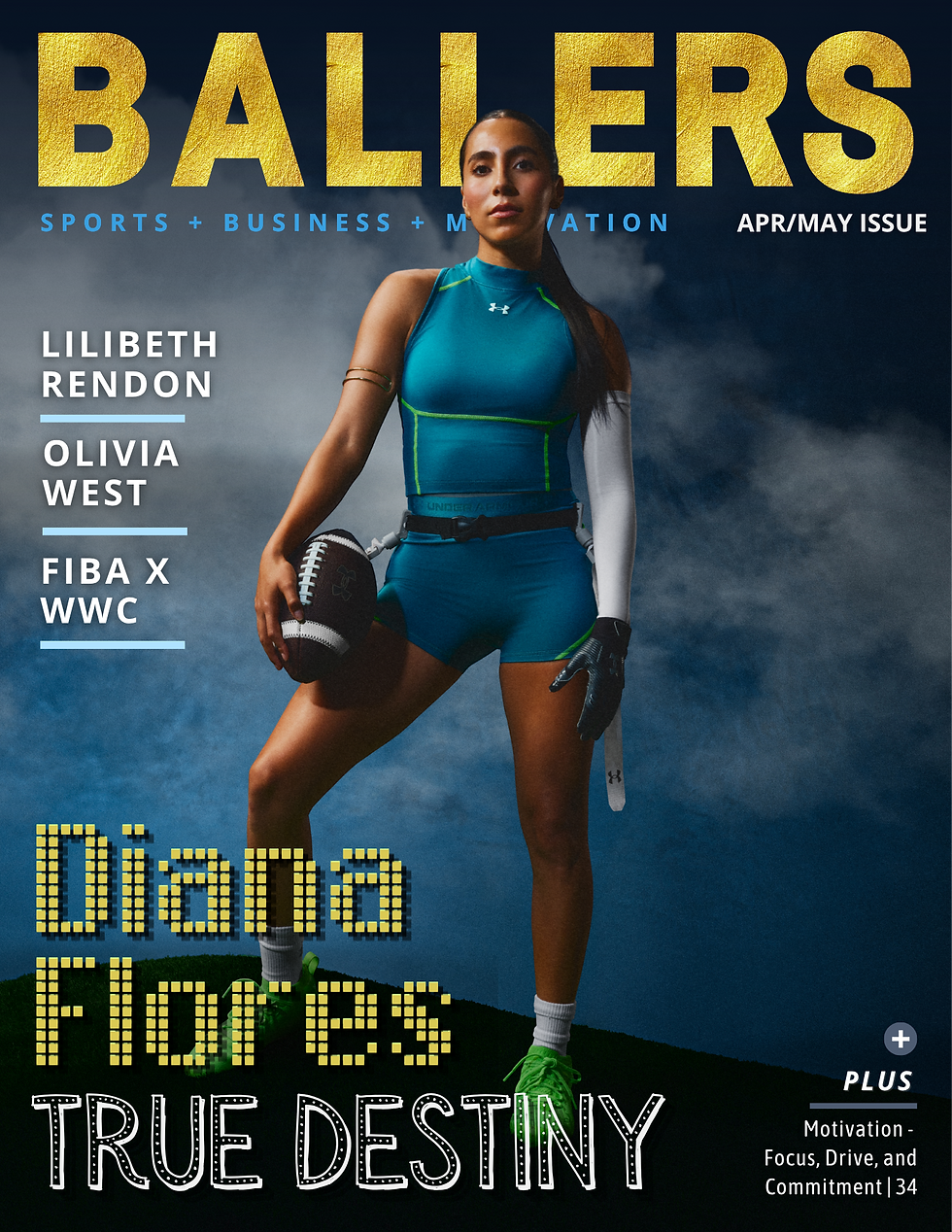
It was only up from there! In 2022, Diana led Mexico to a historic gold medal at the World Games as quarterback and captain of the national team. An accomplishment that became the turning point not only in the recognition and growth of the sport globally, but also in the opportunities that came along to inspire the next generation. Personally for Diana, it was a moment that guided her to discover her true purpose—one that extended well-beyond the field. "It made me find my purpose beyond the field. Life helped me open my eyes and realize that everything that I was doing was no longer
just for me or just for my dreams. Every struggle I had to go through, and that I still have to go through, is not only for me…it's for all the girls that are coming (up) behind me," she highlights. Sure enough, she has done just that. From publishing Flag Football for Dummies with the iconic how-to series to starring alongside Ashlea Klam in "The Future Is Flag" documentary on Prime Video to becoming the first flag football athlete to join the Under Armour family, Diana continues to break barriers and pave the way for the next generation of flag football athletes. Through it all, she remains rooted in her love for the game and grounded by the opportunity to serve as a motivation for others, a voice in the sport, and a strong representation of what's possible. Now that's...TRUE DESTINY!


Take us all the way back! How did you get started in the world of flag football?
I started playing flag football when I was eight (years old), so very young. It was because of my dad. My dad played tackle football when he was in college, so he brought me into this world. I started with other sports like ballet (and) gymnastics, but then I found flag football and completely fell in love with the game. Back then, the sport was not popular. It was not well-known here. It was, of course, seen as a sport for boys only—for men—so there were not a lot of teams. That's why I also say that it was destiny with me getting to find flag (football), because I started playing with girls that were older than me. They were 16 or 17 years old. They were not junior leagues or teams. I think that's another reason that has shaped me in so many ways—not only the sport itself and all the amazing values that it gives you as a person, but also the challenges since I was super young. All the challenges, the lack of opportunities for my team and I. I always saw all these women fighting for (the opportunity to) find a place in this world that made us feel (like) intruders. We couldn't step on the football field because our sport didn't have the respect, so we had to train in the backfield and had to clean it up every day using trash bags to clean all the rocks and all of that. So that's how I started in the game. Later on in this journey, I got to play with boys in all-boys leagues at the age of 14 because that was the only way for me to keep going in the game. You know, I was joining different leagues here in Mexico City and later on in the States as well with boys my age and—for the first time—with girls my age at the age of 14. So I had to wait like six years for that to happen. After that, I started playing in the national team at the age of 16. It has been a long journey, (but) a fun and challenging one.


You mentioned that flag football felt like destiny—your dad played it, he introduced you to the game, and you fell in love with the sport right-away as well. Do you remember that moment when you discovered that you wanted to play the game at the highest level?
That's a good question. When I started playing this game, and even in the years after that, there was no higher level. There was nothing that I (could) look up to and say: “I want to be there.” Back then, I remember that I didn't even know that we had a national team or that there (were) World Cups. All of that was not in my panorama, you know? It was nonexistent. Even when I made it my first time to the national team at the age of 16, I didn't even know. I realized because a lot of people started congratulating me and saying: “That's amazing.” It was a roster of like 80 girls and you had to do all the tryouts to get to the final roster, but still it was the first time I knew that there was a World Cup. It was also very interesting and funny because a lot of the players that used to play in that national team before me, I used to play against (growing up). Because I was just so young, by 14, I was already playing at the highest level here in Mexico so in my mind it was different. It was like, “Okay, I’ve played against them.” Then, I realized that they were part of the national team. Next thing I knew, I was part of the national team as well. It felt like our own world still. You know, nobody knew about the game. Nobody knew about the World Cups. Nobody knew about nothing. I was part of the national team and that almost didn't mean anything for anybody. So I think for me, what kept me going was the pure love of the game. The passion. Scholarships, that wasn't an option…so I knew that if I wanted to keep playing in this game I had to find a way to balance it with my life—with school and with everything else. I think that was the moment (when) I realized that I not only loved the game, and that it was something that I wanted to do forever, but (also) how important it was. The impact it had beyond the field. I realized very young that a lot of the girls that I grew up playing with slowly gave up on the game because they didn't have the support from their families or just the resources to keep going in the game. When I realized that I was the only girl in the field and I couldn't see girls my age, when I realized that I was playing in the U.S. but I was the only Latina—nobody spoke my language, nobody looked like me—, that’s when I started to realize how important it was to stay in that platform and stay in that journey. You know, hoping that other girls like me could be part of it as well.

Love that! Now, let’s dive into your growth within the sport. You mentioned joining Mexico’s National Team when you were just 16 years old. Now, you’re the team captain and you guys have achieved incredible things—including winning back-to-back gold medals. Could you share more with us about your journey there and what that growth with the national team has been like?
Want to read more?
Subscribe to theballersmagazine.com to keep reading this exclusive post.


